

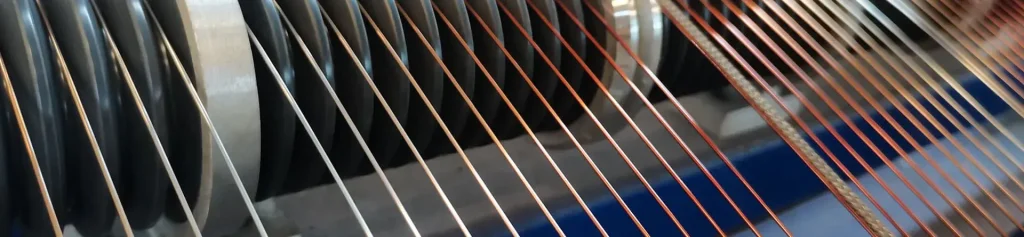
0.22mm 200℃ Magnet Wire
- Key Physical Parameters:
- Nominal Wire Diameter: 0.22mm (Tolerance: ±0.003mm)
- Conductor Cross-Sectional Area: 0.03801mm² (S=πd²/4)
- DC Resistance (at 20℃): ≤0.473Ω/m (Oxygen-Free Copper, Aluminum Wire: 0.785Ω/m)
- Definition of 200℃ Temperature Resistance Class: The magnet wire can operate stably for a long time at 200℃ without insulation aging or conductive performance degradation, requiring compliance with UL 1441 temperature life test and IEC 60317 thermal shock test.
- Magnet Wire Type: The mainstream is enameled wire, with insulation layer closely bonded to the conductor, total outer diameter ≤0.25mm, and insulation layer ratio ≤13.6%.
- Conductor Material Selection: Oxygen-free copper is the mainstream for 0.22mm gauge (conductivity ≥99.9%), suitable for precision motors sensitive to loss; aluminum wire, while 30% lower in cost, has only 61% of copper’s conductivity and higher welding difficulty, making it suitable only for low-power, non-high-frequency auxiliary electronic components.
- 0.22mm 200℃ vs 0.2mm 200℃: The former has a 10% larger cross-sectional area, 8-12% higher current-carrying capacity, and better winding filling rate, avoiding overheating of fine-gauge wires; the latter is only suitable for micro-components with extremely limited space and power ≤5W.
- 0.22mm 200℃ vs 0.22mm 180℃: The 200℃ grade requires higher-performance insulation materials, with the technical barrier lying in the uniform coating of the insulation layer (thickness controlled at 0.015-0.02mm). Its application range extends to 150-200℃ continuous working conditions, while the 180℃ grade can only withstand 130-180℃.
- 0.22mm 200℃ vs 0.25mm 200℃: The former has a 12% smaller total outer diameter, increasing the slot fill factor of micro-motors by 15-20%, suitable for precision windings with stator slot width ≤2mm; the latter has a larger current-carrying capacity but insufficient space adaptability, making it unsuitable for miniaturized equipment.
- Miniature Precision Motors:
- Drone Brushless Motors: Require high-frequency operation in limited space; 200℃ temperature resistance copes with temperature rise after long-time flight, and 0.22mm wire diameter ensures stator winding density ≥75%.
- Medical Device Motors: High-temperature disinfection scenarios + long-term operation; the temperature stability of PI insulation layer prevents equipment failures caused by insulation failure.
- High-Frequency Electronic Components:
- High-Frequency Transformers: Fine-gauge wire reduces skin effect loss; 200℃ temperature resistance adapts to transformer core heating; the low dielectric loss of composite insulation layers improves conversion efficiency.
- Sensor Coils: Small volume requirement; 0.22mm wire diameter can be wound into ≥100 turns to meet sensitivity requirements.
- High-Temperature Environment Equipment:
- Automotive Electronics: Engine compartment temperature can reach 120℃, with operating temperature rise of 60-80℃; 200℃ magnet wire provides sufficient temperature resistance margin.
- Industrial Inverters: Coil temperature rise caused by high-frequency switching + equipment ambient temperature requires 200℃ grade to ensure long-term stability.
- Other Scenarios: Micro-components of new energy equipment, internal wiring of high-temperature test instruments.
- Current Matching Formula: I = S × J
- Winding Space Calculation: Slot Fill Factor = (Sum of Total Cross-Sectional Area of Magnet Wire + Cross-Sectional Area of Insulation Layer) / Stator Slot Volume
- Temperature Resistance Margin Calculation: Ultimate Temperature Resistance = Ambient Temperature + Operating Temperature Rise + Safety Margin
- Alternative Specifications:
- 0.2mm 200℃: Can be used when the equipment current ≤0.18A and space is extremely limited (slot width ≤1.8mm), but insufficient current redundancy should be noted.
- 0.25mm 200℃: Can be used when space allows (slot width ≥2.2mm) and lower loss is pursued, with current-carrying capacity increased by approximately 20%.
- Non-Replaceable Scenarios: Precision equipment that simultaneously meets “fine gauge + 200℃ high temperature + high-frequency operation”, such as drone high-speed motors and high-frequency micro-transformers.
- Insulation Layer Selection Decision:
- Cost Priority: Choose EI/AI composite layer (20-30% cheaper than PI), suitable for mass-produced regular high-temperature equipment.
- Performance Priority: Choose PI, suitable for high-frequency motors and medical devices.
- Extreme Working Conditions: Choose PEEK, suitable for aerospace and corrosive environments.
- Can 0.22mm 200℃ magnet wire be used in 180℃ working conditions? What about cost-effectiveness?
- What is the price difference between 0.22mm 200℃ magnet wires with different insulation layers?
- How to quickly inspect whether the wire diameter of 0.22mm magnet wire meets the standard during procurement?
- What are the differences in application scenarios between 0.22mm 200℃ aluminum magnet wire and copper magnet wire?
- Copper: Suitable for high-frequency, low-loss, and solder-required scenarios, with high conductivity, low loss, and excellent welding performance.
- Aluminum: Suitable for low-frequency, low-power, and cost-sensitive scenarios, with low cost but requiring special aluminum solder for welding; its skin effect loss at high frequencies is more than 30% higher than that of copper.
In precision equipment such as drone motors, ventilator drive modules, and high-frequency transformers, magnet wire serves as the “nerve center” for energy transmission — and 0.22mm 200℃ magnet wire has become a scarce core component for high-end equipment due to its balanced space adaptability and extreme environment stability.
Core Specifications of 0.22mm 200℃ Magnet Wire
1. Product Definition & Key Specifications (Data Compliant with IEC 60317/UL 1441 Standards)
2. Core Materials & Insulation Layer Characteristics
| Characteristic | Polyimide (PI) | Polyester Imide/Polyamide Imide Composite (EI/AI) | Polyether Ether Ketone (PEEK) |
| Long-Term Temperature Resistance | 200℃ | 200℃ | 250℃ |
| Breakdown Voltage (0.22mm Wire) | ≥1.5kV | ≥1.2kV | ≥2.0kV |
| Wear Resistance | Medium | Excellent | Superior |
| Processing Difficulty | Medium | Low | High |
| Application Scenarios | High-Frequency Motors, Sensors | Regular High-Temperature Precision Equipment | Aerospace, Extreme Working Conditions |
3. Differences from Similar Specifications/Temperature Resistance Classes
Application Scenarios of 0.22mm 200℃ Magnet Wire
How to Determine Whether to Select 0.22mm 200℃ Magnet Wire
1. Core Selection Formulas & Calculation Logic
Recommended Current Density at 200℃: Copper magnet wire J=5-6A/mm², Aluminum wire J=3-4A/mm²
Example: A miniature motor with a rated current of 0.2A is perfectly matched with 0.22mm copper magnet wire.
Optimization of 0.22mm Magnet Wire Filling Rate: Adopt tight winding to achieve a slot fill factor of 70-75%; a 5% insulation layer thickness margin should be reserved in calculation.
Example: For an automotive engine compartment with an ambient temperature of 120℃ and a motor operating temperature rise of 60℃, the total temperature must be ≤200℃.
2. Alternative Selections & Application Boundaries
Frequently Asked Questions (FAQ): Addressing High-Frequency Queries in Selection & Procurement
Yes, it can be used, but cost-effectiveness varies by scenario: Low cost-effectiveness for short-term use; high cost-effectiveness for long-term use or fluctuating working conditions — the service life of 200℃ insulation layer is 3-5 times that of 180℃, reducing equipment maintenance costs.
Taking copper magnet wire as an example: EI/AI composite layer ≈120 RMB/kg, PI ≈150 RMB/kg, PEEK ≈380 RMB/kg; the price difference mainly stems from insulation material costs and processing difficulty.
Two methods are recommended: ① Micrometer measurement (take 10 different points, the average value should be between 0.217-0.223mm); ② Laser diameter gauge. Note: The insulation layer must be stripped during measurement to avoid interference from insulation thickness.