

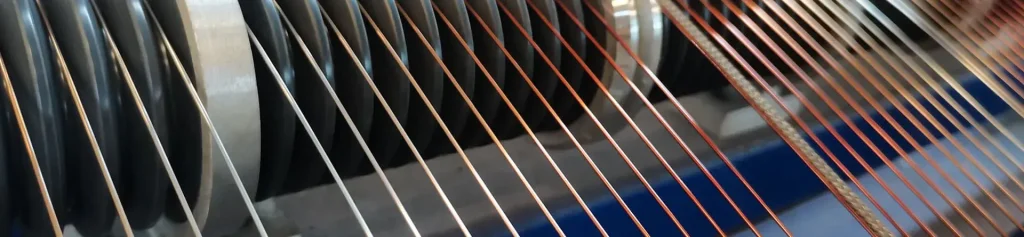
How to select enameled wire
- Performance Priority (e.g., high-frequency transformers): Choose oxygen-free copper (OFC). Reference Document 3 states that “high-purity copper has superior conductivity, reducing losses.”
- Cost Sensitivity (e.g., mass-produced household appliances): Choose aluminum or CCA. Note that “aluminum requires increased wire gauge to compensate for lower conductivity” (mistake reminder in Reference Document 3).
- Lightweight Requirements (e.g., drone motors): Aluminum conductors can reduce weight by over 30%, but anti-corrosion treatment is necessary.
- Normal Temperature Environment (≤80℃): Class A/E (PE insulation)
- Medium Temperature Environment (80℃~150℃): Class B/F (PU/PEI insulation)
- High Temperature Environment (≥150℃): Class H/220℃ (PAI/PI insulation). As noted in Reference Document 3, “Class H or higher is required for new energy vehicle motors.”
- Calculation Logic: Calculate the required current-carrying capacity using the formula “Current-Carrying Capacity (A) = Power (W) / Voltage (V)”, then refer to AWG charts (e.g., Reference Document 3 states “20AWG copper wire has a current-carrying capacity of ≈10A, 30AWG ≈2A”).
- Space Constraints: High-frequency transformers require fine wire gauges (e.g., 30~40AWG) to reduce parasitic capacitance; large motors require thick wire gauges (e.g., 18~24AWG) to minimize resistance losses.
- Solid Wire: High rigidity and winding efficiency, suitable for automatic winding machines (e.g., industrial motors).
- Stranded Wire: High flexibility and fatigue resistance, suitable for manual winding or scenarios with small bending radii (e.g., automotive wiring harnesses).
- Cross-Sectional Area: Balance conductivity efficiency and cost. Example: A 1mm² copper conductor has a current-carrying capacity of ≈6A; an aluminum conductor requires 1.5mm² to achieve equivalent capacity.
- Visual Inspection: No scratches, bubbles, or peeling on the insulation layer (Reference Document 3 notes “uneven insulation is common in low-quality wires”).
- Insulation Performance: Breakdown voltage test (e.g., Class F insulation requires ≥3kV), adhesion test (peeling force ≥5N).
- High-Temperature Aging Test: After 1000 hours in a high-temperature chamber, insulation resistance degradation ≤30%.
- Mechanical Performance: Elongation (copper conductors ≥15%), wear resistance (no copper exposure after 10 friction cycles).
- Export to Europe: CE certification (compliant with RoHS environmental requirements) is required.
- Export to North America: UL certification (e.g., UL 1446 insulation system certification) is required.
- Industrial Equipment: Prioritize suppliers with ISO 9001 certification (Reference Document 3 emphasizes “qualifications are the foundation of quality”).
- Prioritize “copper conductor + PEI/PAI insulation” with temperature resistance ≥155℃ (Class F/H) and high mechanical strength for vibration resistance.
- For high-power motors (≥10kW), select stranded thick wire gauges (18~22AWG) to reduce skin effect losses.
- For high-frequency transformers (≥1MHz), select fine wire gauges (30~40AWG) + PU/PI insulation to reduce parasitic parameters.
- For power transformers, select copper conductors + polyester/PI insulation, focusing on low loss and insulation stability (as recommended in Reference Document 1).
- For guitar pickups, select oxygen-free copper + PU insulation (28~40AWG) for excellent solderability and stable tone (user feedback in Reference Document 3: “PU wire improves tone clarity”).
- For micro-sensors, select PI insulation (220℃ temperature resistance) and fine wire gauges (40~50AWG) to fit compact spaces.
- Select “oil-resistant PAI insulation + tinned copper conductor” with a temperature range of -40℃~155℃ for resistance to fuel corrosion and vibration.
- Charging pile modules require breakdown voltage ≥5kV to prevent high-voltage breakdown risks.
- Qualification Certification: Check for ISO 9001, UL, and IEC certifications, and request batch test reports.
- Production Capacity: Ensure capacity matches demand (e.g., monthly capacity ≥100,000 km for bulk purchases) and delivery time ≤7 days.
- Quality Control: Verify on-line testing equipment (e.g., insulation thickness testers, breakdown voltage testers) and batch stability ≤±5%.
- Technical Support: Confirm availability of customized services (e.g., special wire gauges, insulation combinations) and response time ≤24 hours for selection consulting.
- Industry Reputation: Review customer cases (e.g., cooperation with well-known motor manufacturers) and e-commerce platform ratings ≥4.5 stars (Reference Document 3 suggests “prioritize suppliers with verified cases”).
Enameled wire (also known as magnet wire or winding wire) is a core component of electromagnetic equipment such as motors, transformers, and inductors. Its performance directly determines the efficiency, service life, and safety of the equipment. Based on industry standards and practical application scenarios, this article outlines key selection steps to help users accurately match enameled wire parameters with project requirements.
1. Step 1: Clarify Core Application Requirements & Key Parameters
1.1 Define the Application Scenario
First, identify the equipment type and operating environment to avoid performance waste or failures caused by “one-size-fits-all selection”:
| Equipment Type | Typical Application Scenarios | Core Environmental Requirements |
| Motors (Industrial / Household) | Water pump motors, air conditioner compressors | Temperature resistance ≥120℃, vibration resistance, moderate humidity |
| Transformers (Power / Electronic) | Power transformers, high-frequency transformers | Low loss, insulation stability, compact space |
| Electronic Components (Sensors / Pickups) | Guitar pickups, micro-inductors | Fine wire gauge, high precision, solderability |
| Automotive Electronics | On-board motors, charging pile modules | Oil resistance, wide temperature range (-40℃~155℃), EMI resistance |
2. Step 2: Select the Appropriate Conductor Material
Conductor material directly affects electrical conductivity and cost. The following table compares mainstream options (based on data from Reference Documents 1 and 3):
| Material | Conductivity (Relative to Copper) | Long-Term Temperature Resistance | Mechanical Strength | Cost (Relative to Copper) | Application Scenarios |
| Pure Copper (ETP/OFC) | 100% (Slightly higher for OFC) | 155℃~220℃ | High | 100% | High-end motors, precision transformers, guitar pickups |
| Aluminum | 61% | 120℃~155℃ | Medium | 30%~50% | Low-cost large transformers, lightweight equipment |
| Copper-Clad Aluminum (CCA) | 85% | 120℃~155℃ | Medium | 60%~70% | Mid-range household appliance motors, non-critical circuits |
Selection Decision Logic:
3. Step 3: Choose a Suitable Insulation Layer
The insulation layer must meet temperature resistance, mechanical performance, and chemical stability requirements. The following table outlines characteristics of common insulation materials (refer to detailed classification in Reference Document 3):
| Insulation Material | Temperature Class | Core Advantages | Limitations | Application Scenarios |
| Polyurethane (PU) | Class B (130℃) | Excellent solderability (no insulation stripping needed), high flexibility | Poor solvent resistance, humidity sensitivity | DIY pickups, micro-inductors, manual soldering projects |
| Polyester (PE) | Class A (105℃) / Class E (120℃) | High cost-effectiveness, stable insulation | Low temperature resistance | Small household appliance motors, power adapters |
| Polyesterimide (PEI) | Class F (155℃) | Moderate temperature resistance, balanced cost and performance | Mechanical stripping required before soldering | Industrial motors, small-to-medium transformers |
| Polyimide (PI) | Above Class C (220℃) | Extremely high temperature resistance, radiation resistance | High cost, poor flexibility | Aerospace equipment, high-temperature sensors |
| Polyamide-Imide (PAI) | Class H (180℃) | Wear resistance, solvent resistance, vibration resistance | Special treatment needed for soldering | Automotive electronics, high-voltage motors, harsh-environment equipment |
Temperature Class Matching Principles:
4. Step 4: Determine Conductor Specifications
4.1 Wire Gauge (AWG) Selection
Wire gauge determines current-carrying capacity and winding density, requiring consideration of both “power-space” requirements:
4.2 Conductor Structure and Cross-Sectional Area
5. Step 5: Quality Inspection & Compliance with Standards
5.1 Mandatory Quality Inspection Items
Avoid equipment failures caused by “non-standard wires” by conducting the following inspections:
5.2 Reference to International / Industry Standards
| Standard Code | Issuing Organization | Core Coverage | Target Market |
| IEC 60317 | International Electrotechnical Commission (IEC) | Conductor material, insulation thickness, temperature resistance | Globally applicable (except North America) |
| UL 1441 | Underwriters Laboratories (UL) | Safety insulation class, flame retardancy | North American market |
| GB/T 6109 | Standardization Administration of China (SAC) | Dimensional deviation, performance indicators | Chinese market |
5.3 Certification Requirements
6. Step 6: Application-Specific Selection Tips
6.1 Enameled Wire for Motors
6.2 Enameled Wire for Transformers
6.3 Enameled Wire for Electronic Components
6.4 Enameled Wire for Automotive Electronics
7. Step 7: Select a Reliable Enameled Wire Supplier
FAQ (Frequently Asked Questions)
Q1: Copper vs. Aluminum Enameled Wire – Which is Suitable for My Project?
A: Choose copper for low loss and long service life (e.g., high-end motors); choose aluminum for cost sensitivity and lightweight requirements (e.g., large transformers), but increase wire gauge by 20%~30% to compensate for conductivity. For mid-range scenarios (e.g., household appliances), CCA balances performance and cost.
Q2: How to Calculate the Appropriate Wire Gauge for Enameled Wire?
A: 1. Calculate current-carrying capacity: Current-Carrying Capacity (A) = Equipment Power (W) / Operating Voltage (V); 2. Refer to AWG charts (e.g., 10A requires 20AWG copper wire, 2A requires 30AWG); 3. Space verification: Reduce wire gauge slightly if winding space is limited (ensure current-carrying capacity is sufficient).
Q3: Can a Lower Temperature Class Enameled Wire Replace a Higher One?
A: Not recommended. For example, replacing Class H (180℃) with Class B (130℃) accelerates insulation aging during long-term operation, leading to short circuits or fire risks. Reference Document 3 mandates “Class H or higher for high-temperature environments.”
Q4: What is the Difference Between PI and PEI Insulated Enameled Wire?
A: PI has higher temperature resistance (220℃ vs. 155℃ for PEI) and radiation resistance but is more expensive and less flexible, suitable for aerospace applications. PEI offers moderate temperature resistance, balanced cost and performance, and is more versatile for industrial motors and transformers.
Q5: How to Verify Enameled Wire Quality Upon Delivery?
A: 1. Visual inspection: No scratches or bubbles on the insulation layer; 2. Simple test: Heat PU wire with a soldering iron (should solder directly without insulation stripping); 3. Document verification: Confirm wire gauge and insulation material match the specification sheet, and request batch test reports.