

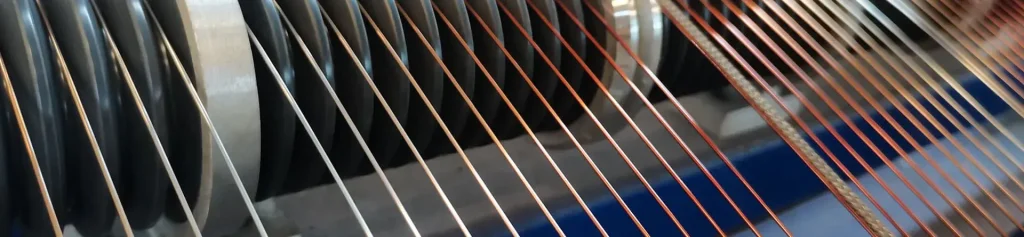
SWG 10 Motor Winding Wire Size
- Nominal wire diameter: 3.251mm, tolerance ±0.04mm
- Actual conductor cross-sectional area: 8.36mm² (pure conductor, excluding insulation layer)
- Long-term allowable current-carrying capacity (25℃ ambient temperature, natural cooling):
- Copper conductor: 50-56A (refer to ASTM B3 standard, specific value depends on insulation temperature rating)
- Aluminum conductor: 34-38A
- Corresponding relationship with other wire gauges: SWG 10 is approximately equivalent to AWG 8. For cross-standard selection, current-carrying capacity matching should be the core to avoid adaptation failures caused by material or insulation differences.
- Conductivity: ≥58MS/m (20℃), the preferred material for motor windings, reducing copper loss and temperature rise
- Temperature resistance range: 105℃ (PVC), 155℃ (XLPE), 220℃ (Polyimide, compliant with IEC 60317-28 standard) depending on insulation type
- Core advantages: High current-carrying capacity, strong oxidation resistance, long service life (15-20 years under normal operating conditions)
- Application scenarios: Motors requiring high efficiency, continuously operating industrial motors
- Conductivity: ≈37MS/m (20℃), about 64% of copper. Wire diameter enlargement is required for compensation, and SWG 10 specification still meets the needs of medium and small motors
- Core advantages: Lightweight, low procurement cost (30-40% lower than copper)
- Limitations: Weak oxidation resistance (requires special insulation treatment); prone to overheating at joints, not suitable for high-frequency start-stop motors
- Application scenarios: Weight-sensitive equipment, low-cost general-purpose motors
- Water pump motors: Agricultural irrigation pumps, industrial circulating water pumps, household booster pumps
- Fan motors: Central air conditioning fans, boiler ventilation fans, workshop exhaust fans
- Compressor motors: Small air compressors, refrigeration compressors
- General mechanical motors: Conveyor motors, mixer motors, small machine tool motors
- Risk points: High temperature reduces conductor current-carrying capacity and accelerates insulation aging
- Selection suggestions: Prioritize copper SWG 10 wire with XLPE insulation (≥155℃) or Polyimide insulation (220℃), and reserve 10-15% current-carrying capacity margin
- Risk points: Insulation is prone to moisture breakdown, and conductor oxidation accelerates
- Selection suggestions: Choose waterproof XLPE insulation with tinned conductor surface; avoid aluminum SWG 10 wire
- Risk points: Enhanced skin effect reduces effective conductor cross-sectional area and increases copper loss
- Selection suggestions: Choose high-precision SWG 10 wire with wire diameter tolerance ≤±0.02mm; use stranded conductor with 7 or more tinned copper wires if necessary to reduce skin effect impact
- Rated current calculation: I = P ÷ (1.732 × U × cosφ × η)
- Current density verification: J = I ÷ S ≤ Maximum allowable value
- Rated current I = 5.5 ÷ (1.732 × 0.38 × 0.75 × 0.88) ≈ 13.1A
- Current density J = 13.1 ÷ 8.36 ≈ 1.57A/mm², far below the maximum allowable value for copper, so SWG 10 copper wire is applicable
- Upgrade gauge (SWG 10→SWG 8): Motor power close to 20HP upper limit, ambient temperature >60℃, requirement for 1-3% motor efficiency improvement
- Downgrade gauge (SWG 10→SWG 12): Motor power <3.7kW, intermittent operation, cost-sensitive with relaxed temperature rise requirements
- Conclusion: Direct replacement is not recommended. AWG 12 has a conductor cross-sectional area of only 4.016mm², with a current-carrying capacity of approximately 28-32A (refer to ASTM B3 standard), far lower than SWG 10.
- Special scenarios: Temporary replacement is allowed only when motor power ≤2.2kW, operating time ≤1 hour per cycle, ambient temperature ≤35℃, and temperature rise requirement ≤80K. However, the number of winding turns must be increased to compensate for inductance; long-term use may cause insulation aging.
- Select XLPE insulation (≥155℃) or Polyimide insulation (220℃);
- Control current density ≤3A/mm² and avoid overload operation;
- Install heat dissipation devices (e.g., cooling fans) on the motor to keep ambient temperature below 80℃;
- Regularly test insulation resistance (should be ≥1MΩ) and winding temperature rise (controlled ≤105K), and replace aging windings in a timely manner.
- Copper wire verification: ① Density test (pure copper density 8.96g/cm³, aluminum 2.7g/cm³); ② Conductivity test (≥56MS/m is qualified); ③ Magnet adsorption (pure copper is non-magnetic, tinned aluminum wire will be significantly adsorbed);
- Qualification review: Request suppliers to provide ASTM B3 or ASTM B230 certification reports, as well as material analysis reports from third-party testing institutions.
- Price ranking (from low to high): PVC insulation < XLPE insulation < Polyimide insulation;
- Specific differences: XLPE is 20-30% higher than PVC, and Polyimide is 120-150% higher than PVC;
- Copper vs. aluminum difference: For the same insulation layer, copper SWG 10 is 35-50% higher than aluminum.
- Prioritize suppliers with ISO 9001 certification and IEC 60317 standard qualifications to ensure product consistency;
- Determine material and insulation layer based on motor operating conditions: Copper XLPE insulation for industrial continuous operation motors, aluminum PVC insulation for mobile equipment, and copper Polyimide insulation for high-temperature equipment;
- Clearly specify key parameters such as wire diameter tolerance, cross-sectional area, and current-carrying capacity during procurement to avoid discrepancies between nominal and actual specifications;
- Store in a dry, low-temperature environment; avoid conductor scratches during winding installation to ensure insulation integrity.
I. Introduction: SWG 10 Winding Wire – The Core of Efficient Motor Operation
As the “bridge” converting electrical energy to mechanical energy, the selection of motor winding wire directly determines motor efficiency, temperature rise control, and service life. SWG (Standard Wire Gauge), an internationally recognized wire diameter standard, with SWG 10 being a commonly used specification in medium and small motor manufacturing and maintenance due to its strong adaptability and stable current-carrying capacity.
Tailored for motor design engineers, maintenance technicians, and electrical procurement professionals, this article systematically breaks down the core parameters, material characteristics, application scenarios, selection logic, and procurement pitfalls of SWG 10 winding wire. It helps readers quickly master the key methods for “selecting the right SWG 10” – all content references international standards such as IEC 60317 and ASTM B3, ensuring professional credibility.
Core Keywords: SWG 10 Motor Winding Wire Size, SWG 10 Winding Wire Selection
II. Basic Understanding: Core Parameters & Standard Definition of SWG 10 Motor Winding Wire
1. Core Definition of SWG Standard & Gauge 10
Originating in 19th-century Britain, the SWG is a widely recognized wire diameter measurement standard in the global electrical industry, suitable for precision electrical components such as motor windings and transformer coils. Its key feature is “smaller gauge number = larger wire diameter,” ranking alongside AWG (American Wire Gauge) and metric as the three major mainstream wire gauge systems.
According to the IEC 60317-0-1 standard, the key parameters of SWG 10 motor winding wire are as follows:
2. Material Characteristics of SWG 10 Winding Wire (Core Procurement Indicators)
(1) Copper SWG 10 Winding Wire
(2) Aluminum SWG 10 Winding Wire
(3) Compatibility of Insulation Types with SWG 10
| Insulation Material | Temperature Rating | Core Characteristics | Application Scenarios |
| PVC (Polyvinyl Chloride) | 105℃ | Low cost, easy processing | Normal temperature conditions, general-purpose motors |
| XLPE (Cross-Linked Polyethylene) | 125℃ | Aging resistance, crack resistance | Medium temperature environments, outdoor motors |
| Polyimide (PI) | ≥220℃ | High temperature resistance, radiation resistance | High temperature conditions, special motors |
III. Core Applications: Suitable Scenarios & Operating Condition Requirements for SWG 10 Winding Wire
1. Matching Range Between Motor Power & SWG 10
The cross-sectional area and current-carrying capacity of SWG 10 determine its core adaptation to medium and small motors of 3.7-15kW (5-20HP). Typical application cases include:
2. Impact of Environment & Operating Conditions on SWG 10 Selection
(1) High-Temperature Conditions (Ambient Temperature >40℃)
(2) Humid Environments (Relative Humidity >85%)
(3) High-Frequency Operation (Motor Frequency >1kHz)
IV. Key Selection: How to Scientifically Determine Whether to Use SWG 10 Winding Wire
1. Core Selection Formulas & Calculation Logic
The core of selection is “current density balance” – ensuring the motor’s rated current does not exceed the allowable current-carrying capacity of SWG 10 while controlling current density within a reasonable range.
(1) Simplified Formulas
Explanation: P = motor rated power (kW), U = rated voltage, cosφ = power factor (0.7-0.8 for medium and small motors), η = motor efficiency (0.85-0.9 for IE2 class)
Explanation: S = SWG 10 conductor cross-sectional area (8.36mm²); maximum allowable current density is 2-5A/mm² for copper and 1.5-3.5A/mm² for aluminum (higher values for better heat dissipation)
(2) Calculation Example
A 5.5kW three-phase induction motor with rated voltage 380V, cosφ=0.75, η=0.88:
2. Comparative Selection Between SWG 10 & Other Specifications
| Wire Gauge | Conductor Cross-Sectional Area (mm²) | Allowable Current-Carrying Capacity (Copper, 25℃) | Core Differences | Selection Suggestions |
| SWG 8 | 10.57 | 65-72A | Thicker wire, higher current-carrying capacity, higher efficiency, higher cost | Motors >15kW, high-temperature conditions, high-frequency operation or frequent start-stop |
| SWG 10 | 8.36 | 50-56A | Balanced cost-performance, wide adaptability | 3.7-15kW motors, normal operating conditions |
| SWG 12 | 6.63 | 40-45A | Thinner wire, lower cost, lower current-carrying capacity | Motors , light-load scenarios |