

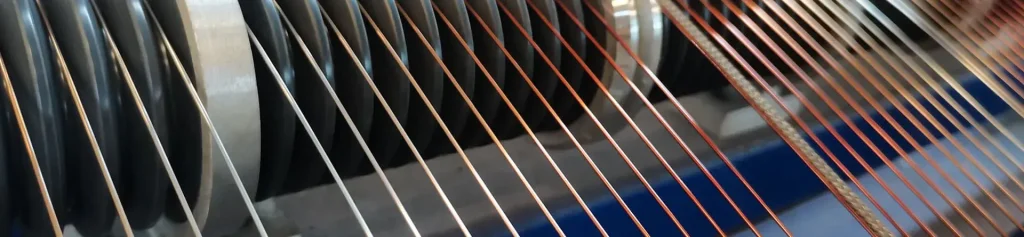
What Is Magnet Wire Used For
- Copper magnet wire: 98% IACS conductivity, low loss, suitable for high-efficiency equipment such as motors and transformers. At the same current-carrying capacity, the annual energy consumption of 380A current is 3,915kWh/km lower than that of aluminum wire, with a full-lifecycle energy difference of 117,450kWh/km.
- Aluminum magnet wire: 61% IACS conductivity, costing only 1/3 of copper. Suitable for low-cost devices such as electric fans and small water pumps, but requires a larger wire diameter (240mm² aluminum equivalent to 150mm² copper).
- Enameled wire: Thin insulation layer (0.01-0.1mm), suitable for conventional electronic devices (mobile phone chargers, headphones) with a temperature resistance grade of 130-180℃.
- Glass Fiber Covered Wire: Thick insulation layer, temperature resistance above 200℃, wear-resistant and radiation-resistant. Suitable for high-temperature equipment (aero-engine motors, industrial oven transformers).
- Conductivity Requirements: Motors and generators require high conductivity (copper magnet wire is preferred), while some equipment can use aluminum magnet wire with reduced specifications.
- Temperature Resistance Environment: New energy equipment requires a grade of 155℃+, equipment in engine compartments should select above 120℃, and conventional environments can choose 130℃ grade.
- Space Constraints: Small electronic devices use 0.02-0.5mm fine-gauge enameled wire, and power equipment uses rectangular copper wire to improve space utilization.
- Cost Budget: High-end equipment selects copper magnet wire, while low-cost civil equipment uses aluminum magnet wire, with a cost difference of up to more than 3 times.
Magnet wire, the “invisible core” of modern electrical equipment, determines the efficiency and lifespan of motors and transformers. Also known as winding wire, magnet wire essentially consists of conductive metal wire (primarily copper or aluminum) coated with an insulating layer. Its core function is to generate magnetic fields through electric current or induce electricity by cutting magnetic fields, serving as the critical medium for converting electrical energy and magnetic energy.
This article comprehensively breaks down over 10 core application scenarios of magnet wire and selection logic across different fields, integrating industry data and technical standards to help you quickly match practical requirements.
Core Application Fields
1. Electrical Power Equipment
Electric Motors
Applicable equipment includes industrial drive motors, household appliance motors (air conditioner/refrigerator compressors, washing machine spindle motors), and new energy vehicle traction motors.
Function of magnet wire: Forming stators and rotors through winding, generating electromagnetic torque when energized to drive equipment operation. For instance, in washing machine motors, the winding density of enameled wire directly affects washing power and energy consumption.
Generators
Used in thermal, hydro, and wind generators, as well as on-board power generation systems. In a 1.5MW wind turbine, the stator winding requires enameled copper wire with a diameter of 0.8-1.2mm, totaling several kilometers in length.
Function of magnet wire: Rotors drive windings to cut magnetic induction lines, generating induced current and realizing efficient conversion from mechanical energy to electrical energy—conversion efficiency is directly related to the wire’s conductivity.
2. Power Electronic Equipment
Transformers
Covering high-voltage transformers in power systems and miniature transformers in electronic devices (mobile phone chargers, power adapters). A 220kV power transformer consumes dozens of tons of rectangular copper wire, while a miniature transformer in a mobile charger only requires a few meters of fine-gauge enameled wire.
Function of magnet wire: Achieving voltage stepping up or down through electromagnetic induction based on the turns ratio of primary and secondary windings. For example, enameled wire windings in mobile chargers convert 220V AC to 5V DC.
Inductors
Widely used in filters, high-frequency oscillators, and RF communication equipment. In RF filters of 5G base stations, high-frequency resistant polyurethane enameled wire is required for winding inductor coils.
Function of magnet wire: Wound coils store magnetic energy, effectively suppressing current surges and forming resonant circuits with capacitors to enhance signal transmission stability.
3. New Energy Sector
Electric Vehicles
Core applications include traction motors, Battery Management System (BMS) inductors, and On-Board Chargers (OBC). The traction motor of a pure electric sedan requires approximately 80kg of copper wire, accounting for 40% of the vehicle’s total copper consumption.
Technical requirements: High temperature resistance, fine gauge (0.1-0.5mm diameter), and high conductivity. Some high-end models adopt rectangular copper wire to further improve efficiency.
Solar/Storage
Mainly used in boost inductors of solar inverters and energy storage BMS. Solar inverters operating above 6kHz require metal alloy powder core magnet wire to adapt to high-frequency working environments.
Function of magnet wire: Reducing energy conversion losses to boost inverter efficiency above 99%. When combined with GaN technology, it can reduce device size by 70%.
4. Industrial and Special Equipment
Sensors
Applied in Hall sensors, electromagnetic flow sensors, and pressure sensors. In electromagnetic flow sensors, magnet wire windings generate uniform magnetic fields; fluid cutting these fields produces electrical signals for flow measurement.
Function of magnet wire: Wound sensitive coils accurately detect magnetic field changes, converting physical quantities into electrical signals with measurement accuracy up to Class 0.5.
Solenoids/Relays
Used in industrial control valves, automotive fuel relays, and home appliance door lock switches. Magnet wire windings in automotive relays generate magnetic fields when energized, driving contact closure with response times less than 10ms.
Function of magnet wire: Energization produces electromagnetic force to actuate valve spools or contacts, enabling circuit switching or fluid control with a service life exceeding 100,000 cycles.
Aerospace/Medical Equipment
Applied in transformers for aircraft avionics systems, gradient coils for Magnetic Resonance Imaging (MRI) equipment, and micro-motors for pacemakers. MRI equipment requires radiation-resistant glass fiber covered rectangular copper wire to adapt to strong magnetic field environments.
Technical requirements: Lightweight (using fine-gauge copper wire), extreme environment resistance (-60℃~200℃ temperature range, radiation resistance), and high reliability.
5. Consumer Electronics and Small Devices
Covering voice coils in headphones/speakers, micro-motors in toys and drones, and drive coils in electronic watches. Headphone voice coils typically use enameled wire with a diameter of 0.02-0.05mm, with hundreds of windings.
Features of magnet wire: Dominated by fine-gauge enameled wire, flexible, and high-frequency compatible.
Magnet Wire Selection Guide
1. Application Differences Between Magnet Wire Types
Copper vs. Aluminum Magnet Wire
Enameled Wire vs. Glass Fiber Covered Wire
2. Core Factors for Selecting Magnet Wire
FAQ
1. What is magnet wire most commonly used for?
The most widespread applications of magnet wire are in household appliances (accounting for 32.28%) and power equipment (accounting for 31.0%), such as air conditioner compressor motors, refrigerator cooling fan motors, and power transformer windings. Its core function is to achieve energy transfer or power drive through electromagnetic conversion.
2. Can magnet wire be used for speakers?
Yes. The core component of a speaker’s voice coil is magnet wire, usually wound with enameled wire with a diameter of 0.02-0.05mm. When energized, it vibrates in a magnetic field to drive the diaphragm to produce sound. The flexibility and conductivity of the magnet wire directly affect sound quality performance.
3. Why is copper preferred over aluminum for magnet wire in motors?
Mainly because copper’s conductivity (98% IACS) is much higher than that of aluminum (61% IACS), and copper magnet wire has lower losses under the same working conditions: taking 380A current as an example, the annual energy consumption of copper magnet wire is 288,495kWh/km, while that of aluminum wire reaches 292,410kWh/km; at the same time, copper has higher mechanical strength, is not easy to break during winding, and can extend the motor lifespan to more than 15 years, while the lifespan of aluminum wire motors is usually only 8-10 years.
4. Is magnet wire suitable for high-frequency applications?
Yes. Enameled wire with high-temperature resistant insulation layers such as polyurethane and polyimide can adapt to high-frequency environments above 50kHz. For example, in solar inverters (above 6KHz) and RF equipment, magnet wire suppresses current surges by storing magnetic energy, and can increase equipment efficiency to above 99% when combined with GaN technology.